Designing a
guided orientation experience
for new Humber students
Designing a
guided orientation experience
for new Humber students
Humber Quest is a mobile orientation experience designed to guide new students through their first weeks at Humber.
Humber Quest is a mobile orientation experience designed to guide new students through their first weeks at Humber.
It brings campus discovery, student services, orientation tasks, events, and wayfinding into a guided experience—helping students focus on what is relevant to them without having to understand Humber's entire digital ecosystem at once.
It brings campus discovery, student services, orientation tasks, events, and wayfinding into a guided experience—helping students focus on what is relevant to them without having to understand Humber's entire digital ecosystem at once.
Product
Product
Humber Quest
Humber Quest
Team
Team
5 Designers
5 Designers
Project Type
Project Type
UX/Product Design (Mobile)
UX/Product Design (Mobile)
Timeline
Timeline
September–November 2025
September–November 2025
Role
Role
Research synthesis · Concept development · Information architecture · Interaction design · Usability testing · High-fidelity UI
Research synthesis · Concept development · Information architecture · Interaction design · Usability testing · High-fidelity UI
Scope
Scope
Research · UX Strategy · Information Architecture · Interaction Design · Prototyping · Usability Testing · UI Design
Research · UX Strategy · Information Architecture · Interaction Design · Prototyping · Usability Testing · UI Design

CONTEXT
CONTEXT
A new campus comes with a new digital ecosystem
A new campus comes with a new digital ecosystem
Starting at Humber involves more than learning where classrooms are located. Students interact with several digital tools, websites, campus services, and physical offices for academics, finances, navigation, wellness, events, and student life.
Our project began by looking at how those existing touchpoints supported the orientation experience.
Starting at Humber involves more than learning where classrooms are located. Students interact with several digital tools, websites, campus services, and physical offices for academics, finances, navigation, wellness, events, and student life.
Our project began by looking at how those existing touchpoints supported the orientation experience.




AUDITING THE EXISTING EXPERIENCE
AUDITING THE EXISTING EXPERIENCE
Understanding what Humber already offered
Understanding what Humber already offered
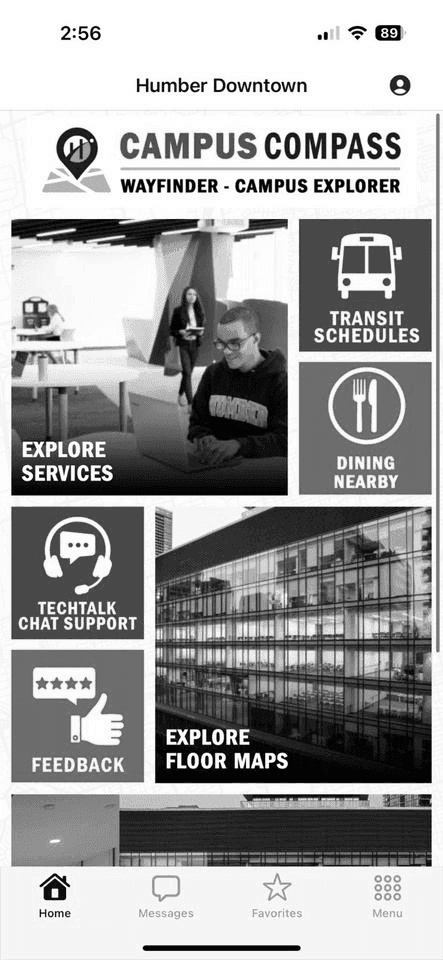
Campus Compass already provided useful campus and transit navigation, floor maps, dining information, accessibility tools, and other wayfinding support. Academic, financial, wellness, and student-life resources, however, existed across other platforms and services.
Campus Compass already provided useful campus and transit navigation, floor maps, dining information, accessibility tools, and other wayfinding support. Academic, financial, wellness, and student-life resources, however, existed across other platforms and services.
USER RESEARCH
USER RESEARCH
How were students actually experiencing orientation?
How were students actually experiencing orientation?
To understand whether the fragmented service landscape was creating real difficulties for students, we conducted qualitative interviews with 8 Humber students aged 18-28 who had already experienced orientation.
The conversations explored how students found their way around campus, which Humber platforms they used, how they discovered support services, and where they experienced friction during their first semester.
To understand whether the fragmented service landscape was creating real difficulties for students, we conducted qualitative interviews with 8 Humber students aged 18-28 who had already experienced orientation.
The conversations explored how students found their way around campus, which Humber platforms they used, how they discovered support services, and where they experienced friction during their first semester.
What we heard ?
What we heard ?
Students were navigation more than one system
Students were navigation more than one system
6 / 8
6 / 8
Felt confused by Humber's multiple apps
Felt confused by Humber's multiple apps
Participants mentioned too many logins, too many notifications, and difficulty remembering which platform handled which task.
Participants mentioned too many logins, too many notifications, and difficulty remembering which platform handled which task.
1 / 8
1 / 8
Had used WeGotYou
Had used WeGotYou
Even useful resources could be difficult to discover. None of the interviewed participants had accessed HPBO.
Even useful resources could be difficult to discover. None of the interviewed participants had accessed HPBO.
5 / 8
5 / 8
Had struggled with printing
Had struggled with printing
Students reported difficulty understanding the printing process and keeping track of their available balance.
Students reported difficulty understanding the printing process and keeping track of their available balance.
4 / 8
4 / 8
Relied more on peers than official platforms
Relied more on peers than official platforms
Half of the participants said they often depended on other students for information rather than knowing which Humber resource to use.
Half of the participants said they often depended on other students for information rather than knowing which Humber resource to use.
*Students described receiving large amounts of information during their first week and reported missing events, resources, Blackboard deadlines, and course information.
SYNTHESIZING THE RESEARCH
SYNTHESIZING THE RESEARCH
SYNTHESIZING THE RESEARCH
The pattern wasn't lack of information
The pattern wasn't lack of information
Humber already had the resources.
Students struggled to understand where they lived, when they mattered, and what to do next.
Three core issues:
Students struggled to understand where they lived, when they mattered, and what to do next.
Three core issues:
Students struggled to understand where they lived, when they mattered, and what to do next.
Three core issues:

Fragmentation
Fragmentation
Important services existed across multiple apps, websites, and physical channels.

Discoverability
Discoverability
Students did not always know what support existed or where to find it.

Information overload
Information overload
Students were being introduced to many tools, services, events, and responsibilities simultaneously.
PROBLEM
PROBLEM
Students needed guidance through the ecosystem—not another platform to learn.
New Humber students need a clearer way to understand what resources are relevant to them, where to find those resources, and what actions deserve their attention during the transition into campus life.
New Humber students need a clearer way to understand what resources are relevant to them, where to find those resources, and what actions deserve their attention during the transition into campus life.

"How might we guide new Humber students through orientation without requiring them to understand Humber's entire ecosystem of apps, websites, services, and physical spaces first?"
HMW
HMW
PRODUCT STRATEGY
PRODUCT STRATEGY
From information access to guided orientation.
From information access to guided orientation.
Rather than trying to rebuild every Humber platform inside one application, we saw an opportunity to create a guidance layer over the existing ecosystem.
Humber Quest would help students discover the right resource, understand what deserves attention now, and move between digital information and the physical campus more confidently.
Rather than trying to rebuild every Humber platform inside one application, we saw an opportunity to create a guidance layer over the existing ecosystem.
Humber Quest would help students discover the right resource, understand what deserves attention now, and move between digital information and the physical campus more confidently.
1.
1.
Discover
Discover
What services and opportunities are available to me?
What services and opportunities are available to me?
2.
2.
Prioritize
Prioritize
What should I be doing right now?
What should I be doing right now?
3.
3.
Navigate
Navigate
Where do I need to go?
Where do I need to go?
IDEATION
IDEATION
Exploring different ways to guide students
Exploring different ways to guide students
Exploring different ways to guide students

CONCEPT 01 - MASCOT MENTOR
CONCEPT 01 - MASCOT MENTOR
CONCEPT 01 - MASCOT MENTOR
A recognizable guide providing continuity and support throughout orientation.
A recognizable guide providing continuity and support throughout orientation.

CONCEPT 02 - QUEST/TASK SYTEM
CONCEPT 02 - QUEST/TASK SYTEM
CONCEPT 02 - QUEST/TASK SYTEM
A structured experience that turns orientation activities into manageable steps.
A structured experience that turns orientation activities into manageable steps.

CONCEPT 03 - CONTEXTUAL NAVIGATION
CONCEPT 03 - CONTEXTUAL NAVIGATION
CONCEPT 03 - CONTEXTUAL NAVIGATION
A stronger connection between digital orientation and the physical campus.
A stronger connection between digital orientation and the physical campus.
*Rather than selecting one concept in isolation, we combined the strongest parts of each into Humber Quest.
*Rather than selecting one concept in isolation, we combined the strongest parts of each into Humber Quest.
EXPERIENCE DESIGN
EXPERIENCE DESIGN
Making orientation feel like a journey, not a checklist
Making orientation feel like a journey, not a checklist
Research showed that students were introduced to a large amount of information, services, and unfamiliar responsibilities during their first weeks at Humber.
Rather than creating another administrative dashboard, we explored how lightweight gamification could make orientation feel more approachable and progressive.
Research showed that students were introduced to a large amount of information, services, and unfamiliar responsibilities during their first weeks at Humber.
Rather than creating another administrative dashboard, we explored how lightweight gamification could make orientation feel more approachable and progressive.

.Humber Quest turns orientation activities into quests. Students complete tasks, earn XP, collect badges, unlock rewards, and track their progress through the experience.
Gamification was not introduced simply for entertainment. It gave us a way to break a complex orientation process into smaller, achievable actions while making progress visible.
.Humber Quest turns orientation activities into quests. Students complete tasks, earn XP, collect badges, unlock rewards, and track their progress through the experience.
Gamification was not introduced simply for entertainment. It gave us a way to break a complex orientation process into smaller, achievable actions while making progress visible.
MASCOT & IDENTITY
MASCOT & IDENTITY





Creating a familiar guide for the experience
Creating a familiar guide for the experience
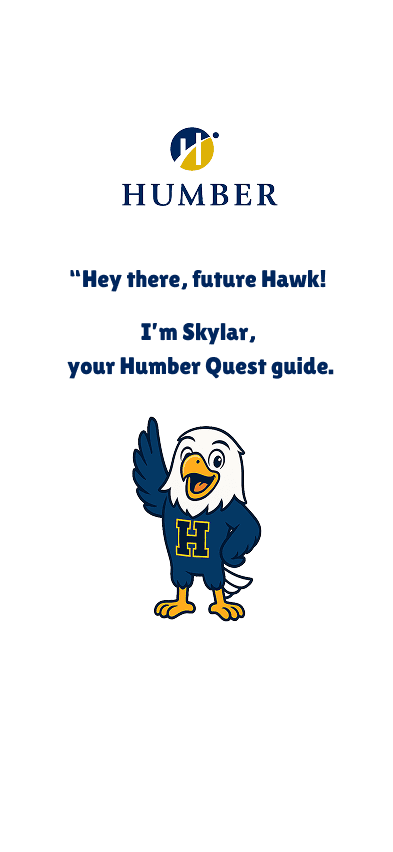
Humber already had an established campus mascot and recognizable visual identity. Rather than introducing an unrelated character, we developed Skylar, a digital mascot inspired by Humber's existing mascot and adapted for the orientation experience.
Skylar was designed to act as a recurring guide across onboarding, quests, progress, and campus touchpoints.
Humber already had an established campus mascot and recognizable visual identity. Rather than introducing an unrelated character, we developed Skylar, a digital mascot inspired by Humber's existing mascot and adapted for the orientation experience.
Skylar was designed to act as a recurring guide across onboarding, quests, progress, and campus touchpoints.
INFORMATION ARCHITECTURE
INFORMATION ARCHITECTURE
Making a complex ecosystem easier to enter
Making a complex ecosystem easier to enter
Humber Quest was structured around the student’s most common orientation needs rather than Humber’s internal organizational structure.
Humber Quest was structured around the student’s most common orientation needs rather than Humber’s internal organizational structure.

STUDENT JOURNEY
STUDENT JOURNEY
Mapping orientation beyond a single day
Mapping orientation beyond a single day
Orientation doesn’t happen at one moment. New students move through a series of digital and physical touchpoints—from receiving their first Humber communications and setting up accounts to exploring campus, discovering support services, attending events, and building a sense of belonging.
We mapped this journey across five stages—Pre-Arrival, Orientation, Explore Campus, Support & Services, and Belonging—to understand when different resources and interactions would be most relevant to students. This helped us identify where Humber Quest could guide the experience while still connecting students to existing Humber platforms, services, and physical campus spaces.
Orientation doesn’t happen at one moment. New students move through a series of digital and physical touchpoints—from receiving their first Humber communications and setting up accounts to exploring campus, discovering support services, attending events, and building a sense of belonging.
We mapped this journey across five stages—Pre-Arrival, Orientation, Explore Campus, Support & Services, and Belonging—to understand when different resources and interactions would be most relevant to students. This helped us identify where Humber Quest could guide the experience while still connecting students to existing Humber platforms, services, and physical campus spaces.

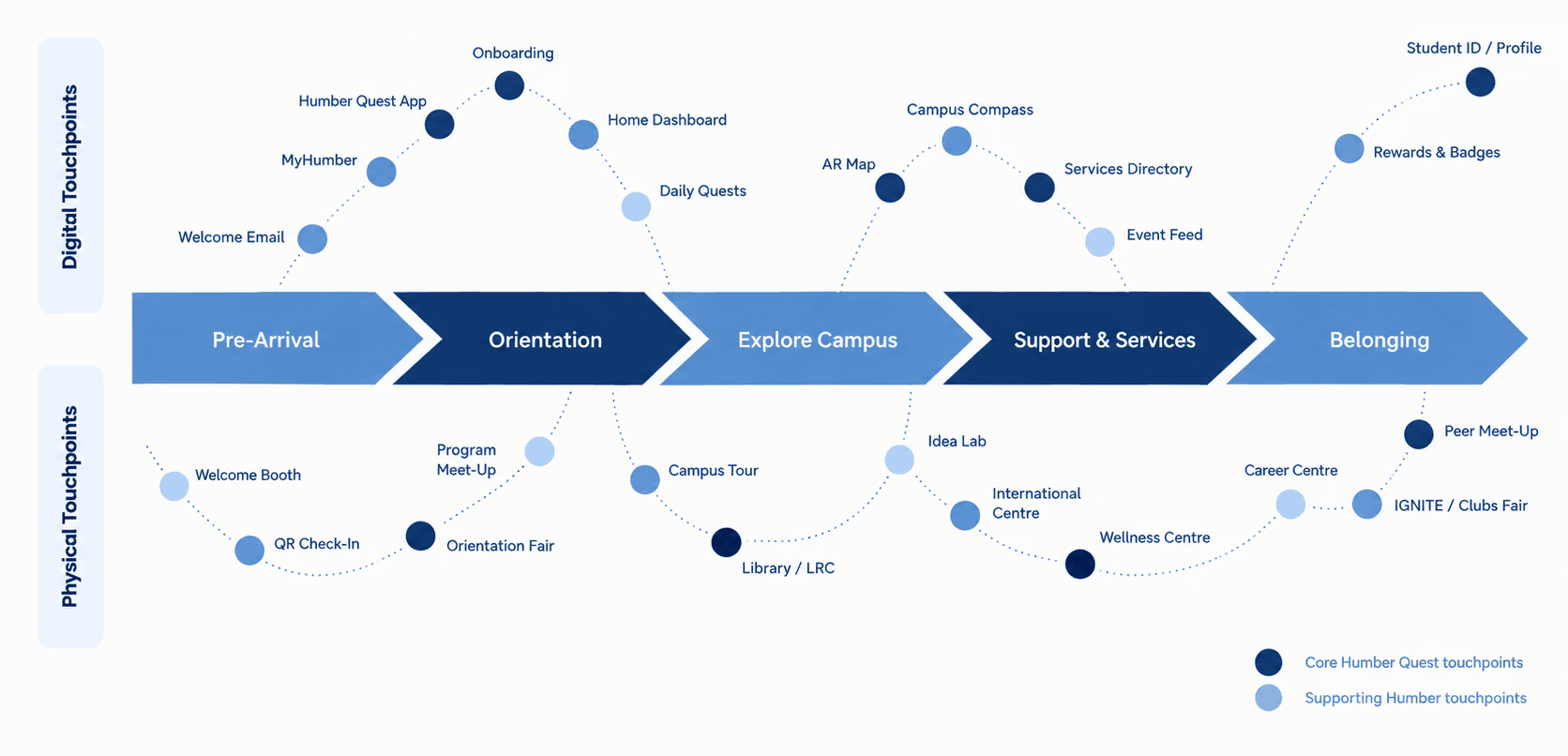
The opportunity: create continuity between disconnected digital and physical touchpoints, so students always have a clearer sense of what to do next, where to go, and where to find support.
The opportunity: create continuity between disconnected digital and physical touchpoints, so students always have a clearer sense of what to do next, where to go, and where to find support.
PROTOTYPE DEVELOPMENT
PROTOTYPE DEVELOPMENT
From early concepts to an interactive experience
From early concepts to an interactive experience
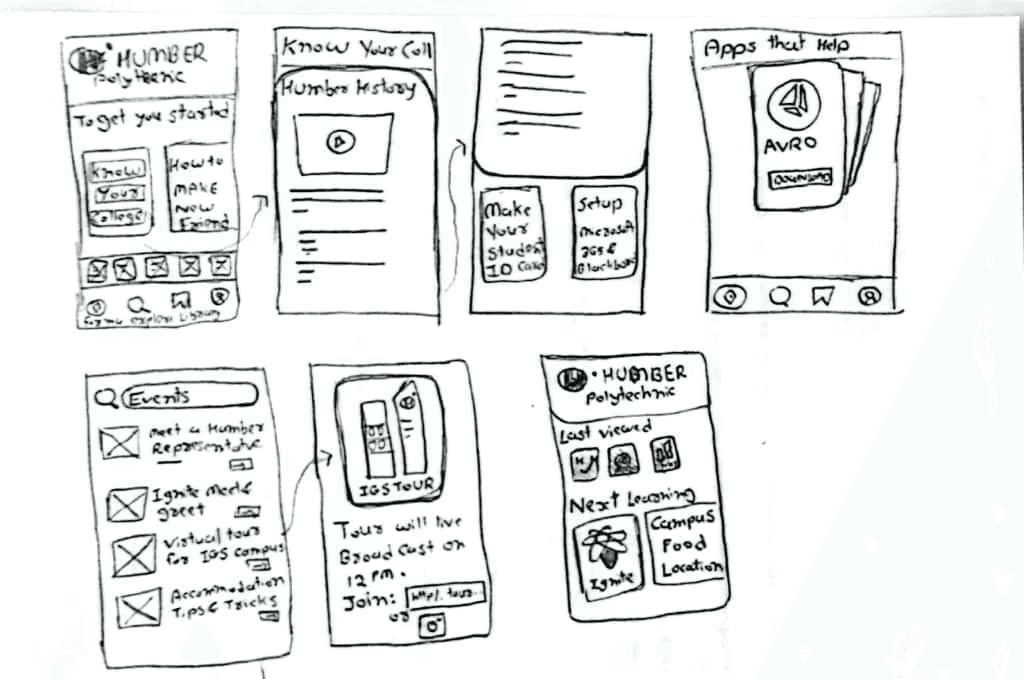
Once the product structure and core mechanics were defined, we progressively translated Humber Quest from sketches into an interactive high-fidelity experience.
Each stage helped refine the information hierarchy, quest system, services experience, and campus navigation before testing.
Once the product structure and core mechanics were defined, we progressively translated Humber Quest from sketches into an interactive high-fidelity experience.
Each stage helped refine the information hierarchy, quest system, services experience, and campus navigation before testing.






VISUAL DESIGN
VISUAL DESIGN
Bringing the gamified experience to life
Bringing the gamified experience to life
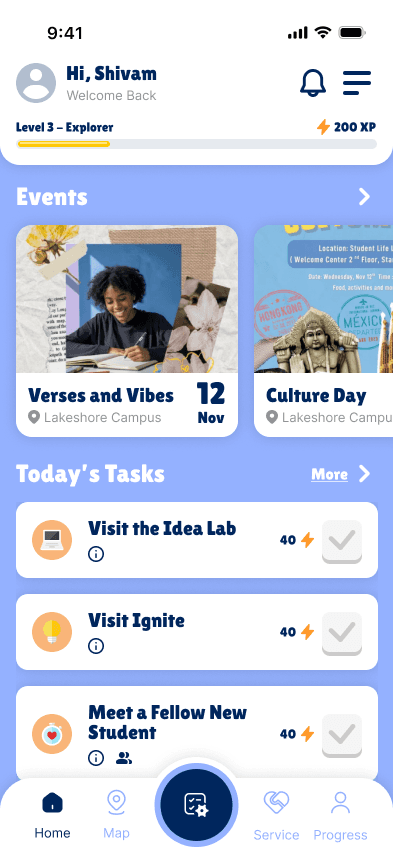
The visual language was designed to make Humber Quest feel more approachable than a traditional institutional portal.
Bright colour, rounded components, progress indicators, badges, and Skylar’s presence reinforce the sense of discovery and progression while keeping important student information easy to scan.
The visual language was designed to make Humber Quest feel more approachable than a traditional institutional portal.
Bright colour, rounded components, progress indicators, badges, and Skylar’s presence reinforce the sense of discovery and progression while keeping important student information easy to scan.

Quest → Complete → XP → Progress → Reward
Quest → Complete → XP → Progress → Reward
Quest → Complete → XP → Progress → Reward
.Humber Quest turns orientation activities into quests. Students complete tasks, earn XP, collect badges, unlock rewards, and track their progress through the experience.
Gamification was not introduced simply for entertainment. It gave us a way to break a complex orientation process into smaller, achievable actions while making progress visible.
.Humber Quest turns orientation activities into quests. Students complete tasks, earn XP, collect badges, unlock rewards, and track their progress through the experience.
Gamification was not introduced simply for entertainment. It gave us a way to break a complex orientation process into smaller, achievable actions while making progress visible.
CORE EXPERIENCE 01
CORE EXPERIENCE 01
Turning orientation into manageable quests
Turning orientation into manageable quests
One of the strongest research themes was information overload. The quest system responds by converting orientation into smaller actions that can be completed progressively.
One of the strongest research themes was information overload. The quest system responds by converting orientation into smaller actions that can be completed progressively.
Relevant now
Relevant now
Relevant now
The dashboard surfaces immediate actions.
The dashboard surfaces immediate actions.
Progressive detail
Progressive detail
Progressive detail
Students can access additional instructions when needed.
Students can access additional instructions when needed.
Visible completion
Visible completion
Visible completion
The system communicates progress through the orientation journey.
The system communicates progress through the orientation journey.
CORE EXPERIENCE 02
CORE EXPERIENCE 02
Making Humber services easier to discover
Making Humber services easier to discover
Research showed that students frequently struggled to know which platform or service handled a particular need.
Humber Quest therefore provides one service-discovery layer where resources are grouped by recognizable student needs before directing students toward the appropriate Humber destination.
Research showed that students frequently struggled to know which platform or service handled a particular need.
Humber Quest therefore provides one service-discovery layer where resources are grouped by recognizable student needs before directing students toward the appropriate Humber destination.
Humber Quest does not need to replace every existing Humber service. It helps students discover the correct one.
Humber Quest does not need to replace every existing Humber service. It helps students discover the correct one.
CORE EXPERIENCE 03
CORE EXPERIENCE 03
Connecting orientation with the physical campus
Connecting orientation with the physical campus
Navigation was already part of Humber's existing Campus Compass experience, so our exploration focused on connecting wayfinding directly with orientation activities and making the route more contextual.
Navigation was already part of Humber's existing Campus Compass experience, so our exploration focused on connecting wayfinding directly with orientation activities and making the route more contextual.
AR-assisted wayfinding concept
AR-assisted wayfinding concept
AR-assisted wayfinding concept
USABILITY TESTING
USABILITY TESTING
Could students understand the system without us explaining it?
Could students understand the system without us explaining it?
We tested the prototype with 4 students, including first-year, international, and students unfamiliar with Humber services.
Sessions combined the think-aloud method, task-completion observation, post-task questions, and post-test interviews.
We tested the prototype with 4 students, including first-year, international, and students unfamiliar with Humber services.
Sessions combined the think-aloud method, task-completion observation, post-task questions, and post-test interviews.
Five testing tasks
Five testing tasks

TESTING SYNTHESIS
TESTING SYNTHESIS
What worked—and where expectations broke
What worked—and where expectations broke
We tested the prototype with 4 students, including first-year, international, and students unfamiliar with Humber services.
Sessions combined the think-aloud method, task-completion observation, post-task questions, and post-test interviews.
We tested the prototype with 4 students, including first-year, international, and students unfamiliar with Humber services.
Sessions combined the think-aloud method, task-completion observation, post-task questions, and post-test interviews.
What worked
What worked
What needed improvement
What needed improvement
Participants understood the Daily Tasks → Points → Progress loop.
The AR-oriented navigation treatment was preferred over the flatter map.
Events were easy to discover and bookmarking was liked.
Services were generally straightforward to navigate.
Navigation generally felt easy and intuitive.
Participants understood the Daily Tasks → Points → Progress loop.
The AR-oriented navigation treatment was preferred over the flatter map.
Events were easy to discover and bookmarking was liked.
Services were generally straightforward to navigate.
Navigation generally felt easy and intuitive.
The meaning of the progress bar was not always obvious.
Rewards were not where some users expected them.
Participants expected the profile image to be interactive.
Some elements appeared clickable when they were not.
The flat map felt less intuitive than the AR-oriented version.
Some map states were unclear.
The meaning of the progress bar was not always obvious.
Rewards were not where some users expected them.
Participants expected the profile image to be interactive.
Some elements appeared clickable when they were not.
The flat map felt less intuitive than the AR-oriented version.
Some map states were unclear.
ITERATION
ITERATION
What testing changed
What testing changed
01 — Profile expectations
01 — Profile expectations

Users expected the profile to do something
Observed
Participants repeatedly attempted to tap the avatar because it matched interaction patterns they already knew from other applications.
Changed
Rather than treating the behaviour as user error, we turned the profile area into a useful entry point for the student’s identity experience.
Result
The updated interaction incorporated access to the student profile and digital ID card.
Users expected the profile to do something
Observed
Participants repeatedly attempted to tap the avatar because it matched interaction patterns they already knew from other applications.
Changed
Rather than treating the behaviour as user error, we turned the profile area into a useful entry point for the student’s identity experience.
Result
The updated interaction incorporated access to the student profile and digital ID card.
02 — Quest clarity
02 — Quest clarity

Quest cards needed more context
Quest cards needed more context
Observed
Students wanted additional information before beginning certain tasks and wanted to know when an activity involved other students.
Changed
We introduced expandable task details and group indicators so students could access more context without making every card permanently dense.
Highlight:
Design principle: Do not assume the user already knows.
Observed
Students wanted additional information before beginning certain tasks and wanted to know when an activity involved other students.
Changed
We introduced expandable task details and group indicators so students could access more context without making every card permanently dense.
Highlight:
Design principle: Do not assume the user already knows.
03 — Navigation
03 — Navigation

The original wayfinding felt too generic
The original wayfinding felt too generic
Observed
Participants felt the original navigation treatment resembled a conventional direction guide and did not communicate the value of the AR concept.
Changed
We moved toward a more contextual route treatment, visually placing the path on the perceived walking surface.
Result
Participants preferred the AR-oriented treatment over the flatter map.
Observed
Participants felt the original navigation treatment resembled a conventional direction guide and did not communicate the value of the AR concept.
Changed
We moved toward a more contextual route treatment, visually placing the path on the perceived walking surface.
Result
Participants preferred the AR-oriented treatment over the flatter map.
04 — Service density
04 — Service density

More information wasn’t always more helpful
More information wasn’t always more helpful
Observed
The original Services cards listed several sub-services beneath each category. Participants described the cards as overwhelming and untidy.
Changed
We removed the secondary lists and relied on clearer headings and iconography, allowing users to enter a category before seeing more detail.
Observed
The original Services cards listed several sub-services beneath each category. Participants described the cards as overwhelming and untidy.
Changed
We removed the secondary lists and relied on clearer headings and iconography, allowing users to enter a category before seeing more detail.
3 / 4
participants successfully found the required pages using the simplified structure.
3 / 4
participants successfully found the required pages using the simplified structure.
OUTCOME
OUTCOME
What we could confidently take away
What we could confidently take away
Humber Quest remained a prototype, so our evaluation focused on usability and comprehension rather than long-term behavioural impact.
Testing suggested that participants generally understood the core navigation model and quest system, while also revealing specific expectation mismatches that directly informed the final design.
Humber Quest remained a prototype, so our evaluation focused on usability and comprehension rather than long-term behavioural impact.
Testing suggested that participants generally understood the core navigation model and quest system, while also revealing specific expectation mismatches that directly informed the final design.
Core game loop understood
Core game loop understood
Daily Tasks → Points → Progress
Daily Tasks → Points → Progress
Services simplified
Services simplified
3 / 4 participants successfully navigated the revised structure
3 / 4 participants successfully navigated the revised structure
Wayfinding preference
Wayfinding preference
Participants preferred the AR-oriented treatment over the flatter map
Participants preferred the AR-oriented treatment over the flatter map
Design System and prototyping
Design System and prototyping
